
Your hard-earned global legacy could be reduced by nearly half before it ever reaches your loved ones. It’s unsettling to realize that without a meticulous strategy, the 40% federal estate tax can act as a silent wealth killer for your international holdings. You likely feel the weight of conflicting legal systems, perhaps worrying how forced heirship rules in Europe or Latin America might clash with your wishes in New York. Effective estate planning for US citizens with foreign assets is the only way to replace this growing complexity with a reliable sanctuary of order.
You deserve a plan that honors your global reach while shielding your family from the chaos of cross-border probate. We promise to help you master the intricacies of worldwide taxation and legal conflicts so your legacy remains secure across every jurisdiction you call home. This 2026 guide provides a clear path through the latest $15 million federal exemptions, treaty benefits that prevent double taxation, and the strategic use of situs wills. We’ll examine how to protect your non-citizen spouse and ensure your children’s future is never left to the mercy of competing international courts.
Key Takeaways
- Learn how the IRS defines “domicile” to understand why your worldwide assets remain subject to US federal estate tax regardless of where you reside.
- Identify the critical differences between Common Law and Civil Law to protect your legacy from foreign forced heirship mandates that could override your wishes.
- Discover how tax treaties and the Foreign Death Tax Credit work together to shield your estate from the unnecessary burden of double taxation.
- Evaluate whether an International Will or a series of country-specific Situs Wills offers the most meticulous protection for estate planning for US citizens with foreign assets.
- Gain clarity on how a unified, cross-border strategy transforms international legal complexity into a sanctuary of order for your heirs.
The Global Reach of the IRS: Why Your Foreign Assets Are Never ‘Out of Sight’
The IRS has a long memory and an even longer reach. If you’re a US citizen, your tax obligations don’t stop at the border. The principle of worldwide taxation means the federal government views your global wealth as a single, taxable unit. Many families mistakenly believe that assets located in a foreign jurisdiction are invisible to US authorities. In reality, ignoring these holdings in your estate planning for US citizens with foreign assets is a recipe for legal chaos and a massive tax bill.
A common misconception is that living abroad or paying taxes in another country exempts your estate from US oversight. This is rarely the case. While you may be a resident of another country for income tax purposes, your “domicile” for estate tax purposes often remains rooted in the United States. This distinction is critical. If your permanent home and intent to return stay tied to New York, the IRS maintains its claim on your entire global portfolio.
Worldwide Asset Reporting and the 40% Tax Rule
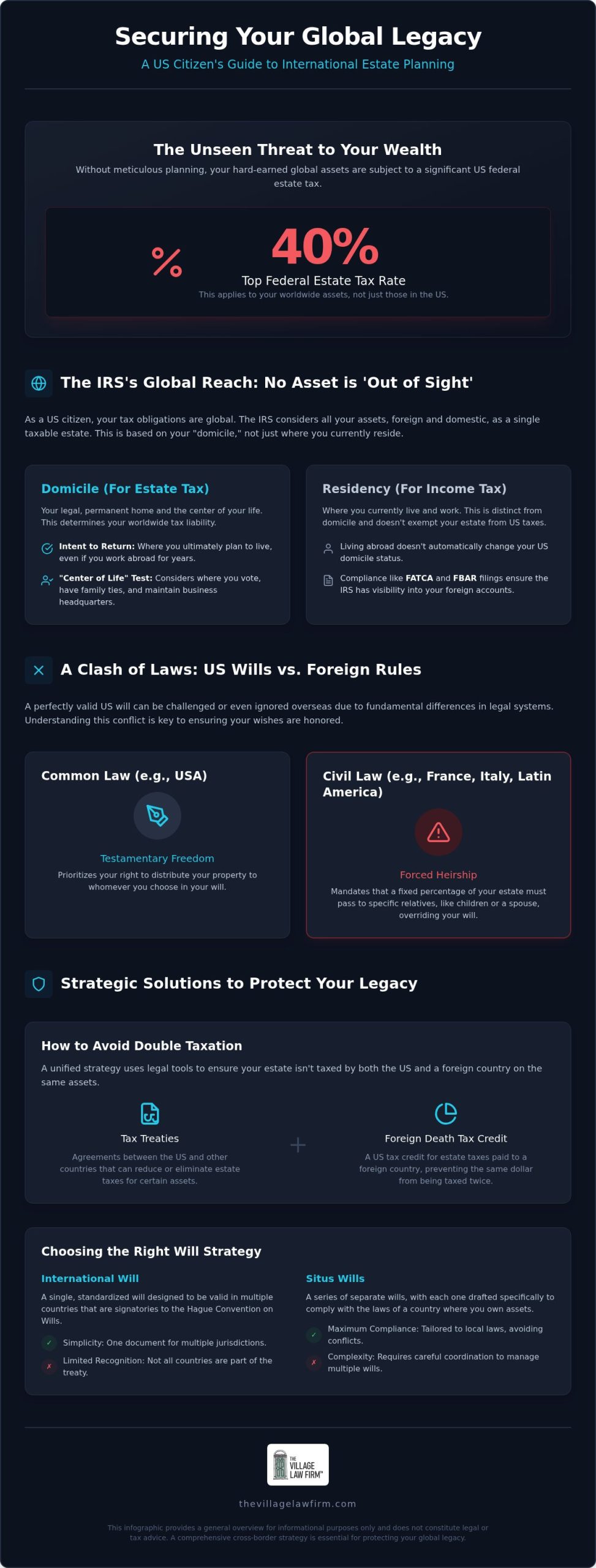
The federal estate tax is a formidable hurdle, often reaching a top marginal rate of 40% for amounts exceeding the lifetime exemption. This tax applies to everything you own. Foreign real estate, offshore bank accounts, and international business interests are all included in the calculation. Transparency is no longer optional. Through the Foreign Account Tax Compliance Act (FATCA) and Foreign Bank Account Report (FBAR) filings, the IRS maintains a clear window into your global holdings. A worldwide estate is a legal net that catches every asset you own globally.
The Domicile Dilemma for Global Citizens
One of the most confusing aspects of international law is the distinction between income tax residency and estate tax domicile. You might spend most of your year working in London or Tokyo. However, if your intent is to return to New York, the IRS still considers you a NYC domiciliary. This determination relies on the “Center of Life” test. Authorities look at where you vote, where your primary business is headquartered, and where your family resides. They even examine where you maintain club memberships or store your most prized personal possessions.
A meticulously documented domicile strategy is the foundation of a sanctuary of order. It prevents the nightmare of double taxation, where two different countries both claim the right to tax your entire estate. We help you define and defend your domicile status, ensuring your estate planning for US citizens with foreign assets is built on a stable, predictable base. By addressing these ties head-on, you replace anxiety with a sense of security.
Legal Conflicts Across Borders: Forced Heirship and the Validity of US Wills
Imagine your New York will is a masterpiece of legal precision. In Manhattan, it’s an ironclad directive. In Paris or Rio de Janeiro, it might be viewed as a mere suggestion. This is the fundamental clash between Common Law and Civil Law systems. While the US tradition prioritizes your right to leave your property to whomever you choose, much of the world operates under a different philosophy. These jurisdictions view inheritance as a social and familial obligation that the state must enforce. For those engaged in estate planning for US citizens with foreign assets, failing to account for this divide can lead to your legacy being dismantled by a foreign court.
The Hague Convention on Wills offers a bridge between these systems, providing a framework for countries to recognize documents drafted abroad. However, not every nation is a signatory. Even in countries that do recognize a New York-drafted will, the “formalities of execution” can create a trap. A document that’s perfectly valid in New York might be rejected overseas because it lacks a third witness or a specific type of consular notarization. When a will is ignored, your property falls into the hands of local intestacy laws, where the state decides the fate of your assets.
Forced Heirship: A Threat to Your Testamentary Freedom
Countries like France, Italy, and many Latin American nations mandate “forced heirship.” These rules require that a fixed percentage of your estate must pass to your children or spouse. You cannot simply disinherit a relative in these jurisdictions, even if you’ve been estranged for decades. To counteract this, we often implement sophisticated “Choice of Law” clauses. Under regulations like the EU Succession Regulation, you may be able to elect for the law of your nationality to govern your assets, bypassing local mandates. This strategy is a vital component of our 2026 guide: international estate planning in New York.
The Validity Trap for Overseas Property
The risk of your NYC plan being ignored is highest when it comes to real estate. Foreign probate courts are notoriously protective of land within their borders. If your will doesn’t meet every local technicality, the court may declare you “intestate” regarding that specific property. This creates a fragmented legacy where your New York assets follow your wishes, but your foreign villa follows a rigid government formula. We coordinate with foreign local counsel to ensure your signatures and witness acknowledgments meet the highest global standards. If you want to ensure your international holdings remain a sanctuary of order, exploring our expertise in cross-border estate administration is a prudent next step.
Mitigating Double Taxation: Treaties and the Foreign Death Tax Credit
The prospect of two different governments claiming a portion of your legacy is a significant source of anxiety. For those managing estate planning for US citizens with foreign assets, double taxation isn’t just a possibility; it’s the default unless you intervene. The primary shield against this is the Foreign Death Tax Credit. This credit allows you to subtract the taxes paid to a foreign country from your US federal estate tax bill. However, it isn’t a perfect solution. The credit is often limited to the amount of US tax attributable to those specific assets. If the foreign tax rate is higher than the US rate, you won’t receive a refund for the difference.
Treaties offer a more sophisticated layer of protection. The US maintains estate tax treaties with sixteen nations, including the United Kingdom, Canada, and Germany. These agreements provide essential “tie-breaker” rules. They determine which country has the primary right to tax specific types of property, such as real estate versus securities. While many anticipated a sunset of tax benefits, the “One Big Beautiful Bill Act” has made the $15 million federal exemption permanent, providing a stable foundation for your long-term legacy. We help you navigate this landscape to ensure your global wealth isn’t eroded by redundant tax claims.
The New York ‘Cliff’ and Global Asset Valuation
Living in NYC adds a unique layer of complexity. While the federal exemption is now a permanent $15 million per individual, New York state maintains a much lower threshold. In 2026, the New York exemption is approximately $7.35 million. New York is famous for its “tax cliff.” If your total estate, including your global holdings, exceeds this limit by more than 5%, you lose the entire exemption. This makes accurate global asset valuation mandatory. You must understand how New York Estate Tax Exemption 2026: Navigating the Cliff impacts your specific situation. We create a double-layered strategy that protects you from both the 40% federal rate and the unforgiving New York cliff.
Utilizing Estate Tax Treaties Effectively
Effective treaty use requires more than just reading the text. It involves coordinating tax filings across different languages, time zones, and legal standards. We provide the meticulous attention to detail required to ensure your foreign credits are applied correctly. This white-glove approach ensures that your estate planning for US citizens with foreign assets remains a sanctuary of order. By securing “pro-rata” credits through these treaties, we can often effectively increase your available exemption. We act as your steady guide, navigating the nuances of international law to preserve the maximum value of your legacy for your spouse and children.
Strategic Drafting: Choosing Between International Wills and Situs Wills
When you hold property across different continents, the structure of your legal documents determines whether your transition is a seamless handoff or a multi-year litigation nightmare. There are two primary schools of thought. The first is the “One Will” approach, utilizing an International Will under the Washington Convention. This treaty allows a single document to be recognized in participating countries. It offers simplicity. However, it often lacks the granular detail required by foreign banks or local land registries. For many, the “Situs Will” strategy is the gold standard of estate planning for US citizens with foreign assets. This involves having a separate, country-specific will for your assets in each jurisdiction.
The challenge with multiple wills is the risk of accidental revocation. A standard New York will usually begins by stating it revokes all prior wills. If you sign a French will after your New York will, you might inadvertently cancel your entire US plan. We meticulously “nest” these documents. Each will must explicitly state that it only governs assets in a specific country and does not revoke your plans elsewhere. This creates a unified front. Order is the goal. We also ensure your choice of guardians for minor children is consistent across every document. You don’t want a New York court and a foreign tribunal debating who should care for your family.
When to Use a Situs (Local) Will
A Situs Will is almost always necessary for foreign real estate, especially in civil law jurisdictions. Local judges and clerks are often uncomfortable interpreting a foreign document. A local will, written in the native language and following local formalities, speeds up the probate equivalent significantly. It bypasses the need for expensive translations and expert testimony on New York law. This proactive approach mirrors how we handle Ancillary Probate in New York: Managing Out-of-State Assets, ensuring that every piece of property is accounted for in its own home court.
Coordinating Your Global Legal Team
Your NYC attorney acts as the Lead Architect of your global plan. We don’t just draft your New York documents; we review your foreign wills to ensure they harmonize with your overall goals. Your US will must explicitly mention your foreign property to avoid any ambiguity regarding your intent. We manage the chaos of multi-jurisdictional administration by acting as the central hub for communication. This white-glove service replaces unpredictability with a sense of security. If you are ready to build a plan that truly spans the globe, contact us for a sophisticated consultation on your international holdings.
Meticulous Protection: How The Village Law Firm Secures Your Global Legacy
Securing a legacy that spans multiple borders requires more than just a passing knowledge of international law. It demands a level of precision that views your global wealth as a single, protected sanctuary. At The Village Law Firm, our “white-glove” philosophy is designed specifically for busy New York professionals who value efficiency and meticulous attention to detail. We don’t just draft documents; we act as your protective partner. Effective estate planning for US citizens with foreign assets is about replacing the chaos of international legal conflicts with a sense of profound security. We understand the emotional weight of these decisions, and we’re committed to ensuring your family’s future remains unshakeable.
Our expertise in cross-border estate administration is particularly vital for those rooted in New York. While federal exemptions are high, the New York state “tax cliff” remains a significant threat to global portfolios. If your international holdings push your total estate just 5% over the New York threshold, you could lose your entire state exemption. This unique local nuance requires a sophisticated strategy that most generalist firms simply don’t provide. We bridge the gap between New York’s rigid tax rules and the unpredictable nature of foreign jurisdictions, creating a unified plan that works everywhere you have a footprint.
A Steady Urban Guide for Global Families
Families with children face the highest stakes in the international arena. Conflict between US guardianship laws and foreign mandates can leave your children’s care in the hands of a distant court. We specialize in removing this complexity, providing a clear path for parents who need to coordinate protection across different legal systems. Our approach is defined by honesty and transparency. We invite you to explore our NYC Estate Planning: 2026 Parent’s Guide to Legal Security to see how we prioritize your family’s well-being. By focusing on the human element of the law, we transform technical mechanics into long-term peace of mind.
Schedule Your Sophisticated Global Audit
The first step toward order is a comprehensive global asset inventory and a deep domicile review. We look at your business ties, social connections, and property holdings to ensure your estate planning for US citizens with foreign assets is built on a stable foundation. In an unpredictable world, a premium legal partnership is your most valuable asset. We walk alongside you with compassion and a commitment to excellence, shielding you from future uncertainty. When you are ready to replace international anxiety with a sanctuary of order, schedule a consultation to secure your international legacy and protect the wealth you’ve spent a lifetime building.
Securing Your Global Legacy in an Unpredictable World
Your global footprint is a testament to your success, but it shouldn’t be a source of constant legal anxiety. You’ve learned that the IRS’s reach is truly worldwide and that navigating the New York estate tax cliff requires a meticulous, double-layered strategy. By choosing between International Wills and Situs Wills with precision, you can bypass the rigid mandates of forced heirship and ensure your wishes are honored in every jurisdiction. Proper estate planning for US citizens with foreign assets transforms a complex web of international regulations into a sanctuary of order.
At The Village Law Firm, we provide the sophisticated, white-glove service that busy New York professionals require. Our specialized expertise in cross-border estate administration ensures that every detail of your international holdings is handled with unwavering integrity. We are dedicated to providing long-term legacy protection for families with children, shielding your loved ones from the chaos of multi-jurisdictional probate. You deserve a partner who walks alongside you with compassion and technical excellence.
Take the final step toward peace of mind today. Request a Sophisticated Consultation for Your International Estate and let us help you build a shield against future uncertainty. Your international legacy is ready to be secured.
Frequently Asked Questions
Does my New York will cover my property in another country?
Yes, a New York will can technically cover international property, but foreign courts often struggle to interpret it. While the Hague Convention provides a framework for recognition, local land registries in civil law countries frequently demand documents that follow their specific formalities. For real estate, relying on a single US document often leads to expensive translations and probate delays. We typically recommend a country-specific Situs Will to ensure your global assets transition smoothly.
Will my foreign assets be taxed by the IRS when I die?
Your global wealth is subject to federal oversight regardless of where the assets are located. The IRS applies a 40% tax rate to your worldwide estate once you exceed the 2026 federal exemption of $15 million. This includes everything from a London flat to an offshore investment account. Meticulous estate planning for US citizens with foreign assets is the only way to ensure these holdings don’t trigger an unexpected and devastating tax bill for your heirs.
What is forced heirship and how does it affect my US estate plan?
Forced heirship is a legal mandate common in civil law jurisdictions that requires a fixed portion of your estate to pass to specific relatives. This can directly conflict with your US will if you intend to distribute assets differently. In countries like France or Italy, these rules can override your testamentary freedom. We use Choice of Law clauses to help you elect US law, ensuring your personal wishes take precedence over foreign mandates.
Do I need a separate will for every country where I own assets?
It isn’t always mandatory, but it’s the gold standard for protecting foreign real estate. Having a separate Situs Will for each jurisdiction avoids the need for a foreign judge to interpret New York law. It also prevents the “revocation trap” where a new will accidentally cancels an old one. For liquid assets, a single well-drafted International Will might suffice, but real property almost always requires a more localized and meticulous approach.
How does the US estate tax treaty system work?
The US maintains estate tax treaties with 16 countries to prevent you from being taxed twice on the same dollar. These treaties act as tie-breakers to determine which country has the primary taxing authority over specific assets. They can also provide pro-rata credits that effectively increase your available exemptions. Coordinating these treaty benefits requires a sophisticated understanding of both US and foreign tax codes to ensure your family retains the maximum possible value.
Can a non-citizen spouse inherit my foreign assets tax-free?
Non-citizen spouses do not qualify for the unlimited marital deduction, which can create a significant tax trap. For 2026, you can gift up to $194,000 annually to a non-citizen spouse tax-free, but amounts beyond that or assets left at death are subject to estate taxes. To protect your spouse, we often implement a Qualified Domestic Trust (QDOT). This structure allows for the deferral of estate taxes while providing your spouse with the security they deserve.
What happens if I own real estate in a country that doesn’t recognize trusts?
Many civil law jurisdictions in Europe and Latin America do not recognize the legal concept of a trust. In these countries, a trust might be treated as a taxable corporation or simply ignored, leading to your property being distributed according to local intestacy laws. If you own real estate in such a jurisdiction, we coordinate with local counsel to use alternative structures. This often involves a Situs Will or a local holding company to maintain your legacy.
How can I avoid double taxation on my international property?
Avoiding double taxation requires a combination of the Foreign Death Tax Credit and strategic treaty utilization. The credit allows you to subtract foreign taxes paid from your US bill, though it’s often limited to the US tax rate on those specific assets. Comprehensive estate planning for US citizens with foreign assets ensures these filings are coordinated across jurisdictions. This meticulous approach prevents redundant tax claims from eroding the sanctuary of order you’ve built.