
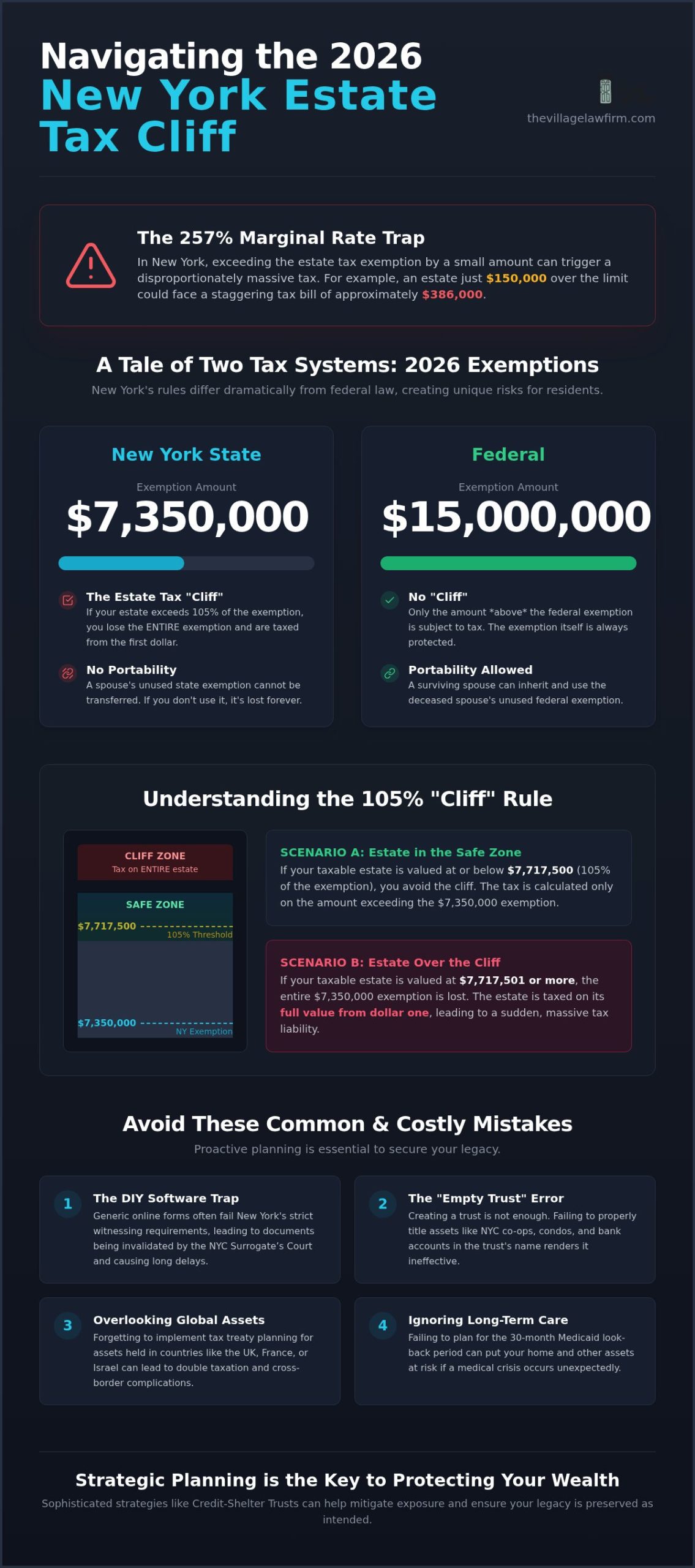
Did you know that exceeding the New York estate tax exemption by just $150,000 could trigger a tax bill of approximately $386,000? This staggering 257 percent marginal rate is the reality of the New York estate tax cliff in 2026. It’s a sharp reminder that in a city as fast-paced as ours, a single oversight can jeopardize a lifetime of achievement.
You likely feel the weight of this complexity, especially if you’re balancing international assets or the future of minor children. The NYC Surrogate’s Court process shouldn’t be a source of anxiety, yet without a precise strategy, it often becomes one. This 2026 New York estate planning checklist is designed to transform that potential chaos into a sanctuary of order. We’ll walk alongside you through the nuances of the new $7,350,000 state exemption, the permanent $15 million federal limit, and the specific protections required for global wealth. You’ll gain a clear, expert-led roadmap that secures your legacy and provides the peace of mind you deserve.
Key Takeaways
- Discover why generic DIY software often fails New York’s strict witnessing requirements, causing avoidable delays and stress in the NYC Surrogate’s Court.
- Understand the 105 percent rule and how to shield your legacy from the unique New York estate tax cliff that can tax your entire estate from the first dollar.
- Avoid the common mistake of the “empty trust” by ensuring NYC co-ops, condos, and beneficiary designations are meticulously aligned with your legal documents.
- Use this New York estate planning checklist to identify cross-border risks and implement treaty planning for assets held in countries like France, Israel, or the UK.
- Secure your future by proactively addressing the 30 month Medicaid look back period and protecting your home equity before a medical crisis occurs.
The DIY Software Trap: Why Generic Forms Fail in New York
The allure of a fifty dollar online form is understandable for a busy professional. It promises speed and a fleeting sense of completion. However, New York law is notoriously unforgiving. A “valid” document is simply one that meets the bare minimum to be recognized by a clerk. An “effective” plan is one that actually performs under pressure. Generic software frequently misses the nuances of the New York Estates, Powers and Trusts Law. Improper witnessing isn’t a minor clerical oversight; it’s a fatal flaw. Every last will and testament must be executed with strict compliance to state statutes to survive a challenge. Without this precision, your New York estate planning checklist remains incomplete, leaving your legacy vulnerable to the very chaos you sought to avoid.
The NYC Surrogate’s Court Reality
The Surrogate’s Court in New York City operates as a high-volume, high-stakes environment where precision is the only currency. If your documents lack a “self-proving affidavit,” the court may demand that your witnesses be located and testify years after the signing. In a transient, global city like ours, witnesses move, change names, or pass away. Tracking them down creates a logistical nightmare that can freeze your assets for months. The financial burden of fixing a DIY error often dwarfs the cost of professional drafting. It’s the difference between a custom-fitted shield and a generic paper umbrella that folds at the first sign of a storm.
Why Simple Wills Often Create Chaos
A common misconception is that a simple Will keeps your family out of court. It does not. A Will is essentially a formal petition to a judge, and it must pass through the probate process before a single asset can be moved. This reality is why a partnership with an estate planning attorney New York is a strategic necessity. We act as your steady urban guide, replacing the cold, transactional feel of software with deep emotional intelligence and technical mastery. Drafting errors in a generic form can trigger expensive Will contests or family litigation, pitting loved ones against each other during their most vulnerable moments. By choosing a sophisticated, expert-led approach, you ensure your New York estate planning checklist leads to a sanctuary of order, protecting both your global wealth and the people you love most.
Navigating the New York Estate Tax Cliff and Portability
New York’s tax code presents a unique challenge that many high-net-worth professionals overlook until it’s too late. While the federal government offers a generous exemption, New York imposes a “cliff” that can decimate a legacy if not managed with technical precision. The New York estate tax cliff is a legal mechanism where an estate valued at more than 105 percent of the current state exemption loses its entire tax exclusion, subjecting the total value of the estate to taxation from the first dollar. This isn’t a gradual increase in rates; it’s an all-or-nothing trap. If your estate’s value is just slightly over that 105 percent mark, the state taxes the whole amount, potentially costing your heirs hundreds of thousands in avoidable fees.
Unlike the federal system, New York does not recognize “portability.” This means you can’t simply inherit your spouse’s unused state exemption. If you don’t use your exemption at the time of your passing, it’s gone forever. This absence of portability makes a meticulous analysis of the New York estate tax “cliff” an essential part of your New York estate planning checklist. Without specific planning, a surviving spouse might find their combined assets pushed far beyond the cliff, inviting aggressive taxation that could have been avoided with a more sophisticated approach.
The 2026 Tax Landscape for New Yorkers
As of January 1, 2026, the New York estate tax exemption has transitioned into a confirmed $7,350,000 threshold. While the federal exemption has risen to a permanent $15,000,000 under the “One Big Beautiful Bill Act,” NY residents face a widening gap between state and federal protections. High-net-worth NYC residents often require credit-shelter trusts to ensure both spouses can utilize their full state exemptions. This mismatch between state and federal law requires a steady urban guide to ensure your strategy remains effective as tax landscapes shift.
Strategic Trust Planning to Mitigate Exposure
Shielding your wealth requires more than just a basic Will. A sophisticated irrevocable trust attorney NYC can help you implement lifetime gifting strategies that lower your taxable estate below the critical cliff. It’s vital to remember that New York has a three-year “claw-back” for taxable gifts, so timing is everything. Meticulous asset valuation is particularly important for NYC professionals holding real estate or private equity, where market values can fluctuate rapidly. Integrating these tax-saving vehicles into your New York estate planning checklist ensures your legacy remains a sanctuary of order. If you’re concerned about how these numbers impact your family, consider discussing your specific tax exposure with a partner who understands the high stakes of Manhattan wealth.
The Empty Trust and Outdated Beneficiary Designations
A Trust is often described as a sophisticated legal vehicle, but it’s more accurate to view it as an empty container. You can spend weeks crafting the perfect distribution plan, yet if you fail to formally retitle your assets, the container remains empty. This oversight is a primary reason why families still end up in Surrogate’s Court despite having a Trust in place. For NYC professionals, this typically manifests in the failure to transfer a co-op or condo into the Trust. Unlike a standard deed transfer, moving a co-op requires navigating board requirements and management company protocols. If this step is missing from your New York estate planning checklist, that valuable Manhattan real estate will still be subject to probate.
Consistency is equally vital when managing beneficiary designations on retirement accounts like 401(k)s and IRAs. These designations operate independently of your Will or Trust. If you updated your Will recently but left an ex-spouse or a deceased relative as the beneficiary on your brokerage account, that contract usually overrides your written wishes. This misalignment creates a fracture in your sanctuary of order, potentially diverting wealth away from your intended heirs. Meticulousness here isn’t just about paperwork; it’s about ensuring your intent is actually realized.
Protecting the Next Generation in NYC
For families, the stakes are even higher. Naming minor children as direct beneficiaries is a frequent but dangerous mistake. New York law generally prohibits minors from directly owning significant property. If a child inherits assets directly, the court may appoint a guardian to manage the funds, often with high administrative costs and strict oversight. By using our NYC Parent’s Guide to Legal Security, you can learn how to structure a Trust where a chosen Trustee manages the inheritance. This ensures your children are protected from their own financial inexperience until they reach a mature age, providing a steady hand long after you’re gone.
A Checklist for Funding Your New York Trust
Funding your Trust is an active, ongoing process rather than a one-time event. Every time you open a new brokerage account or acquire property, you must ensure the ownership reflects your Trust’s name. We recommend coordinating closely with your financial advisor to verify that every account is properly titled. This level of detail is what separates a valid document from a truly effective shield. While you’re focusing on current wealth, you should also consider the risks of Failing to Plan for Long-Term Care and Medicaid Eligibility, as how you title assets today impacts your future eligibility for state support. Regular reviews of your New York estate planning checklist will capture these new acquisitions and keep your legacy secure.
Overlooking Foreign Assets and Cross-Border Complexity
NYC is a global hub. Your life likely reflects that. If your portfolio includes a villa in France, an apartment in Israel, or a flat in the UK, your New York estate planning checklist must account for international borders. Many people mistakenly believe their local Will automatically governs their global footprint. It doesn’t. Foreign jurisdictions often have their own rigid rules that can clash with your intentions. Without specialized international estate planning, you risk leaving your family to navigate a labyrinth of foreign courts and conflicting laws.
Taxation is another high-stakes variable. Foreign real estate can be subject to “double taxation” if you haven’t utilized proper treaty planning. This isn’t just about paying more; it’s about the administrative burden of filing in two countries simultaneously. We help you replace this complexity with a sanctuary of order. Meticulous coordination is the only way to shield your global wealth from unnecessary depletion.
Managing Global Assets with Precision
Countries like France operate under “forced heirship” regimes. These laws dictate exactly how much of your estate must go to specific family members. This stands in stark contrast to New York’s freedom of disposition, where you generally decide who inherits your wealth. Reconciling these two philosophies requires coordinating multiple Wills across different jurisdictions. It’s a delicate balance. Additionally, if you are a non-resident with NYC property, you must understand how ancillary probate New York procedures work. This process is often a logistical nightmare for families, requiring a local court to recognize a foreign Will before assets can be distributed.
The Cross-Border Estate Administration Challenge
Distributing assets across international borders involves more than just translating documents. It requires an intimate knowledge of how US and foreign legal systems interact. You need specialized cross-border counsel to manage these hurdles efficiently. We act as your steady urban guide, bridging the gap between disparate legal frameworks to ensure your global wealth remains protected. Our firm specializes in this meticulous coordination, ensuring that your New York estate planning checklist covers every acre and account, regardless of the time zone. If you have assets abroad, schedule an international asset review with our team today to ensure your legacy is truly borderless.
Failing to Plan for Long-Term Care and Medicaid Eligibility
Waiting until a medical crisis to consider long-term care is one of the most common oversights in a New York estate planning checklist. By the time an emergency arises, your options for asset protection are severely limited. The state of New York implements a 30 month look back period for Community Medicaid and a 60 month period for nursing home care. This means any assets transferred or gifted within those windows could disqualify you from receiving benefits when you need them most. Without a proactive strategy, your hard earned wealth can be rapidly depleted by the high costs of NYC healthcare, which frequently exceed fifteen thousand dollars per month for institutional care.
A Medicaid planning attorney New York acts as your guide through these shifting regulations. We help you navigate the risk of estate recovery, where the state seeks to recoup its costs from your family home after you pass away. For most New Yorkers, the home is their largest asset; allowing it to be consumed by medical debt is a tragedy that is often entirely avoidable. Meticulousness today ensures that your property remains a sanctuary for your heirs rather than a source of repayment for the state.
Protecting the Family Home from Recovery
We utilize sophisticated tools like the Medicaid Asset Protection Trust (MAPT) to shield your real estate while maintaining your right to live in the home. By transferring property into a MAPT, you start the look back clock and eventually qualify for care without being forced to spend down your entire life savings to the $33,038 asset limit for a single applicant. This approach provides an immense emotional benefit. It replaces the fear of losing your home with the quiet confidence that your legacy is secure. You can qualify for the care you need while ensuring your children inherit the full value of the family estate.
Planning for Incapacity Before It Happens
Legacy protection isn’t just about what happens after you’re gone. It’s about maintaining control while you’re here. Overlooking the Power of Attorney or Healthcare Proxy leaves your future in the hands of a court appointed stranger. In New York, a “Statutory Gift Rider” is an essential addition to your Power of Attorney. It grants your agent the specific authority to move assets into a trust if you become incapacitated, a move that is vital for late stage Medicaid eligibility. This final step on your New York estate planning checklist transitions you from a state of unpredictability into a sanctuary of order, ensuring you are cared for on your own terms. We walk alongside you to ensure every document is precise, protective, and professional.
Securing Your Sanctuary of Order for 2026 and Beyond
The complexities of a global life in New York City require more than just a stack of documents; they demand a living strategy that evolves with you. By moving beyond the DIY software trap and meticulously funding your trusts, you ensure your legacy isn’t left to the whims of the Surrogate’s Court. Addressing the $7,350,000 New York estate tax cliff now prevents a catastrophic tax burden for your heirs later. Whether you are managing cross-border assets or protecting your family home through strategic Medicaid planning, every step on your New York estate planning checklist should be a deliberate move toward permanent security.
At The Village Law Firm, we provide white-glove service tailored to the high-stakes needs of NYC professionals. Don’t leave your family’s future to chance. Our specialized international and cross-border expertise, combined with our role as Medicaid asset protection specialists, allows us to act as your steady urban guide. You’ve worked hard to build your wealth; let us help you shield it from future uncertainty with technical precision and a human touch. Secure your legacy with a sophisticated, urban guide; schedule your consultation with The Village Law Firm today.
Frequently Asked Questions
Can I use a DIY Will in New York if my estate is relatively small?
You technically can use a DIY Will for a small estate, but New York’s strict witnessing laws make this a gamble. Even a modest estate must pass through the NYC Surrogate’s Court, where minor clerical errors lead to months of delay. A professional touch ensures your document is not just valid but effective. This prevents your loved ones from facing unnecessary litigation or administrative hurdles during a time of grief.
What exactly is the ‘Cliff’ in the New York estate tax?
The “cliff” is a unique New York tax mechanism where exceeding the exemption by more than 5 percent triggers tax on the entire estate. In 2026, the exemption is $7,350,000. If your assets reach $7,717,500, the state taxes every dollar starting from zero. This results in an effective marginal tax rate that can exceed 250 percent. Meticulous planning is required to keep your estate safely below this threshold.
Do I need a separate Will for assets located outside the United States?
You often need a separate Will or a coordinated international strategy for foreign assets. Many countries, such as France or Israel, have “forced heirship” rules that clash with New York’s freedom of disposition. Relying on a single New York Will for a flat in London or a villa in Paris can cause legal chaos. We coordinate with local counsel abroad to ensure your global wealth remains protected and accessible to your heirs.
How does the Medicaid look-back period work in New York in 2026?
New York enforces a 30 month look back period for Community Medicaid and a 60 month period for nursing home care. During this review, the state examines all asset transfers to ensure you didn’t give away wealth just to qualify for benefits. If you transferred assets within these windows, you may face a penalty period of ineligibility. Proactive planning with a Medicaid Asset Protection Trust is essential to start this clock early.
What happens if I name a minor child as a beneficiary in my Will?
Naming a minor child as a direct beneficiary typically triggers a court-supervised guardianship. New York law generally prevents minors from managing significant inheritances directly. The court will appoint a guardian to oversee the funds, which often involves high administrative fees and annual reporting. Most parents prefer using a Trust, which allows you to choose a Trustee and determine when your children are mature enough to receive their inheritance.
Is a revocable trust enough to avoid the New York estate tax?
A revocable trust is an excellent tool for avoiding probate, but it doesn’t shield your assets from the New York estate tax. Because you maintain control over the trust, the state still considers those assets part of your taxable estate. To mitigate tax exposure, your New York estate planning checklist should include credit-shelter trusts or irrevocable gifting strategies. These sophisticated vehicles are specifically designed to reduce your taxable footprint while protecting your legacy.
How often should I update my New York estate plan?
You should review your plan every three to five years or whenever a major life event occurs. Births, deaths, marriages, or significant changes in your net worth can all render an existing plan obsolete. In a fast-paced city like NYC, tax laws and real estate values shift rapidly. Regular updates ensure your strategy remains a sanctuary of order, reflecting your current intentions and the latest legal requirements for 2026 and beyond.
What is the difference between probate and estate administration in NYC?
Probate is the court process used to validate a last Will and testament and appoint an executor. Estate administration, or “intestate administration,” occurs when someone passes away without a Will. In NYC, both processes take place in the Surrogate’s Court and can be time-consuming. However, administration is often more complex because the state’s default laws determine who inherits your assets, which may not align with your personal wishes or family dynamics.